Basics Of English.

What is the Basics Of English ?

Key elements of basics of english.

When you begin your journey to learn English, the very first step is to understand what the basics of English is. Just like a house needs a strong base, English learning starts with alphabets, vowels, consonants, semi-vowels, and the basic structure of sentences such as the subject and object. In this article, we will explore these core concepts step by step with clear definitions and simple examples to help you build a strong foundation in the English language.

1. English Alphabets

( Basics Of English)  The alphabet is the starting point of the language. Without knowing the alphabets, it is impossible to read, write, or pronounce English words.

GRAMMAR

Journey starts form alphabets

english alphabet chat

Definition:

The English alphabet consists of 26 letters. Each letter has two forms:

  • Uppercase (capital letters): A, B, C, D, E, F, G, H, I, J, K, L, M, N, O, P, Q, R, S, T, U, V, W, X, Y, Z
  • Lowercase (small letters): a, b, c, d, e, f, g, h, i, j, k, l, m, n, o, p, q, r, s, t, u, v, w, x, y, z

2. Vowels in English

Definition:

Vowels are the heart of the English language. Because they are essential for forming syllables and giving words their rhythm and flow. Without vowels, it would be almost impossible to pronounce words clearly. They connect consonants and create the core sounds in every word. That’s why they’re considered the heart of the language. (Vowels in English)

In English, there are five (5) vowels: A, E, I, O, U.

Example:vowel

  1. A – Apple
  2. E – Elephant
  3. I – Ice
  4. O – Orange
  5. U – Umbrella

3. Semi-Vowels in English

Definition:

( Basics Of English)  Some letters in English act like vowels and consonants depending on their use. These are called semi-vowels.

The letters Y and W are called semi-vowels because sometimes they behave like vowels and sometimes like consonants.

Examples of semi-vowels:

  1. Y in Yes → consonant sound.
  2. Y in Cry → vowel sound.
  3. W in Water → consonant sound.
  4. W in Cow → vowel sound.
  5. Y in Yellow → consonant sound.

4. Consonants in English

Definition:

Consonants are letters in the English alphabet that are not vowels. There are 21 consonants in total.

Consonants List:

B, C, D, F, G, H, J, K, L, M, N, P, Q, R, S, T, V, W, X, Y, Z

Examples of consonants in words:

  1. B in Ball
  2. C in Cat
  3. M in Mango
  4. S in Sun
  5. T in Tiger

5. Subject in English Grammar

Definition:

( Basics Of English)  After learning alphabets and letters, the next step in English grammar is understanding sentence structure. Every sentence has a subject and an object. Let’s begin with the subject.

The subject of a sentence is the person, place, thing, or idea that does the action or that the sentence is about.

 Examples of subjects in sentences:

  1. Ram plays cricket. (Ram = subject)
  2. The dog is barking. (dog = subject)
  3. She sings well. (She = subject)
  4. Books give us knowledge. (Books = subject)
  5. Children are playing. (Children = subject)

6. Object in English Grammar

Definition:

The object of a sentence is the person, place, or thing that receives the action of the verb.


Examples of objects in sentences:

  1. Ram plays cricket. (cricket = object)
  2. She reads a book. (book = object)
  3. They built a house. (house = object)
  4. He bought a car. (car = object)
  5. The teacher teaches students. (students = object)

7. Difference Between Subject and Object

It is important to know the difference between subject and object.

Understanding Imperative Sentences in English.

Before we begin learning this topic, let’s look at a few simple examples.
Think about what you say when you want someone to do something.

You might say:

  •  “Sit down.”
  •  “Open your notebook.”
  • “Please help me.”

All of these are imperative sentences because they tell someone to take action.

What is an Imperative Sentence in English?

Definition:

An imperative sentence is a type of sentence used to give a command, make a request, offer advice, or give an instruction.
It is commonly used when the speaker wants the listener to do something.

Imperative sentences usually begin with a verb, and the subject “you” is understood — it is not written but implied.

For example:

  • (You) Sit down.
  • (You) Open the door.

These sentences typically end with a full stop (.), but if the command shows strong emotion or urgency, it may end with an exclamation mark (!).

Examples in Daily Use

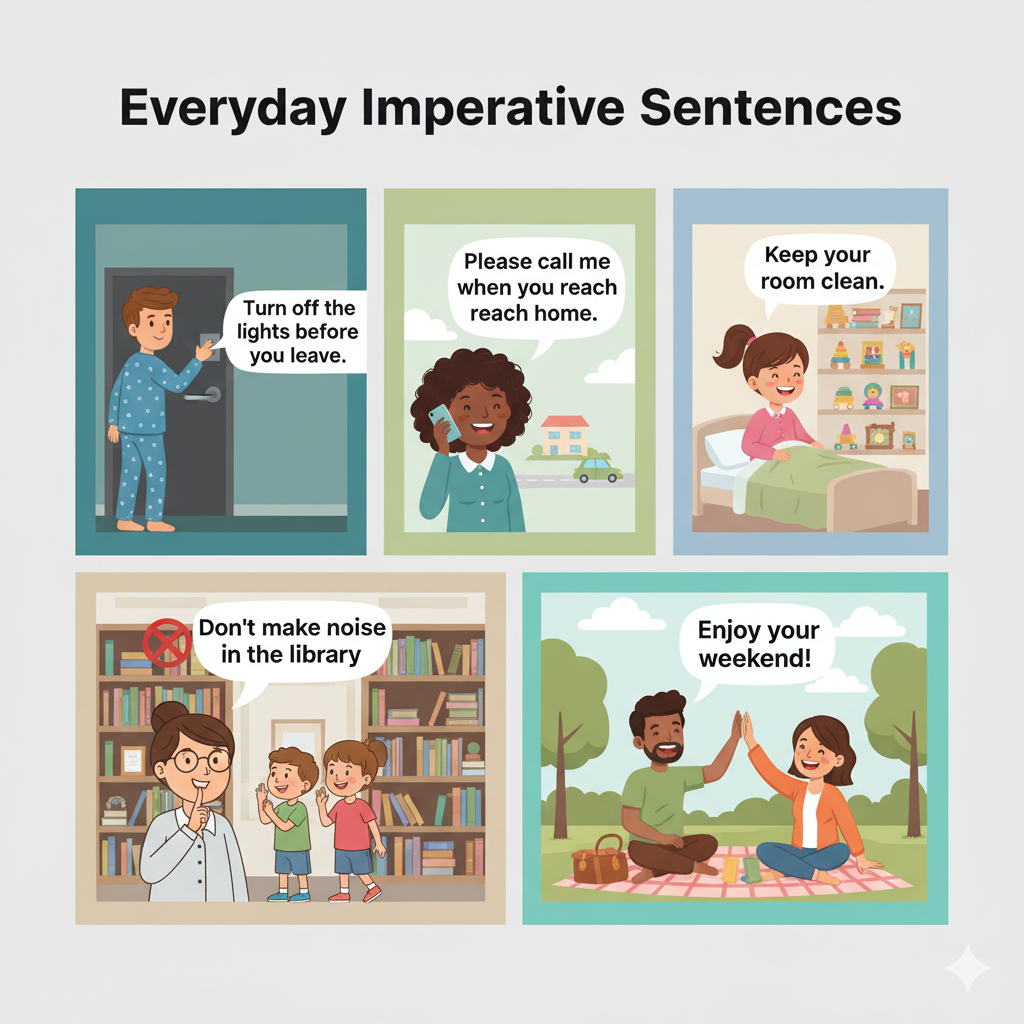
Daily use imperative sentence example
  • Turn off the lights before you leave.
  • Please call me when you reach home.
  • Keep your room clean.
  • Don’t make noise in the library.
  • Enjoy your weekend!

Important Features of Imperative Sentences

  1. The subject “you” is usually implied, not written.
    • Example: (You) Sit down.
  2. The sentence starts with a base verb (first form of the verb).
    • Example: Open, Read, Write, Go.
  3. It usually ends with a period (.) or exclamation mark (!).
  4. Used for commands, requests, suggestions, or directions.

Formula of Imperative Sentences

To form an imperative sentence, you don’t always need to write the subject. The subject “you” is understood because the sentence directly addresses the listener. ( Basics Of English)

Imperative sentence type
  • Open the book.                   (You) + Verb + Object)
  • Don’t touch that.      Don’t / Do not + Verb + Object
  • Please sit down.               Please + Verb + Object        
  • Do come in.                                  Do + Verb + Object            

TEST SECTION

“You have now learned the basics of English in this lesson. To check your understanding and strengthen your learning, take the quick exam below.
This test will help you:

  • Review the key points from the lesson.
  • Identify your strengths and areas to improve.
  • Build confidence in using English effectively.

Click on the ‘Start Exam’ button when you’re ready. Don’t worry — this is just for practice, and every attempt helps you learn better.”

Conclusion

An imperative sentence is an essential part of English grammar. It helps you express commands, requests, and instructions clearly and directly. Understanding imperative sentences improves both speaking and writing skills, making communication more effective and confident. ( Basics Of English)

Leave a comment